
Wisconsin lien-waiver basics for small residential contractors
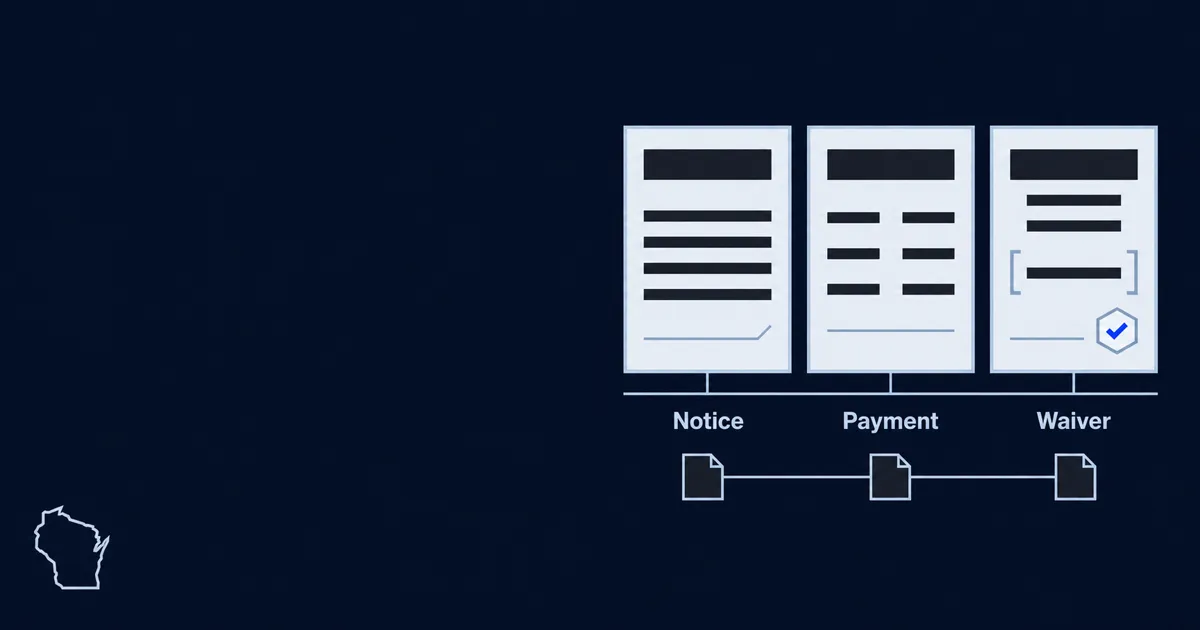
The bathroom is nearly finished. The homeowner is ready to make the next payment, then asks, "Can you get me lien waivers from everybody?"
You have your invoice. You paid the plumber. The tile supplier's statement is in your email. You know where the money went.
But those are not all the same document.
A useful lien-waiver process connects the payment to the people and work it covers. It also starts earlier than the final walkthrough. On a covered Wisconsin home-improvement job, the first step belongs before the customer enters the contract.
First, separate three different documents
Similar names make this topic harder than it needs to be.
| Document | What it does | What it does not do |
|---|---|---|
| Notice of the consumer's right to receive lien waivers | Tells the customer about the right to request waivers | It does not itself waive anyone's lien rights. |
| Notice of construction lien rights | Addresses potential lien rights under a different requirement | It is not a substitute for the consumer's lien-waiver notice. |
| An actual lien waiver | Gives up the signer's lien rights to the extent stated in the document | It does not automatically waive another contractor's or supplier's rights. |
An invoice tells someone what you are charging. A payment record shows a payment. A waiver addresses lien rights. Keep those functions separate even when the records concern the same amount. Wisconsin DATCP's liens guide explains the distinction between lien notices and waivers.
The notice comes before the contract
For covered home-improvement contracts, ATCP 110.025(1) requires advance written notice of the buyer's right to request waivers. Use the rule's prescribed wording, a separate document, clear and conspicuous type, and a format the buyer can retain. Retain evidence of the buyer's acknowledgement of receipt. A sentence buried in the contract is not this separate notice.
Scope matters. ATCP 110 excludes new-residence construction and a "major renovation": a renovation or reconstruction whose total contract price exceeds the existing structure's assessed value when the contract is initiated. An extensive remodel is not automatically a major renovation under that definition. Other lien laws may still apply outside ATCP 110.
The practical question for your next contract is simple: where in the signing process does the customer receive the separate notice, and where do you keep the acknowledgement?
A request can apply to progress payments
When the buyer requests waivers, ATCP 110.025(2) requires written waivers from all contractors, subcontractors, and material suppliers for the proportionate value furnished or delivered as of payment. Unless the buyer limits the request to final payment, waivers are also due at partial payments.
That is why "we sort out waivers at the end" can become a problem. The customer's request may already apply to the next progress payment.
Treat collecting the waivers as a planned payment task, not a surprise request passed down the chain on Friday afternoon.
Read the scope before you sign
A waiver deserves the same attention as the payment it accompanies.
Wisconsin's section 779.05 makes a signed waiver potentially binding even without payment for it and even before the work is performed. Ambiguity is construed against the signer. Unless specifically and expressly limited, a waiver can reach all the signer's lien rights on the improvement. The section also allows a claimant to refuse a waiver unless paid in full for the work or materials it covers.
The takeaway is not to obstruct a proper waiver request. It is to coordinate payment and an accurately limited waiver with counsel-approved documents. Do not sign a broad waiver because someone says, "It is just a receipt," or assume an unpaid invoice makes the waiver harmless.
Check the project, signer's identity, covered work, amount, and any through-date. If the payment covers only part of the job, the waiver should not accidentally say something broader. A heading that says "partial" is not a reason to ignore the rest of the page.
Build a payment record you can actually follow
Consider a fictional bathroom remodel involving your company, a plumbing subcontractor, and a tile supplier. Before a progress payment, you want one place to see:
| Party | Work or supply reference | Payment record | Waiver record |
|---|---|---|---|
| Your company | Contract and progress invoice 02 | Customer payment date and reference | Your waiver and its stated scope |
| Plumbing subcontractor | Rough-in invoice P-14 | Payment date and reference | Subcontractor waiver for the covered work |
| Tile supplier | Delivery tickets and invoice T-28 | Payment date and reference | Supplier waiver for the covered materials |
This is a recommended tracking format, not a legal waiver form. The amounts in the different rows do not necessarily match: a customer progress payment can cover several costs, labor, and the contractor's margin.
Keep unresolved entries visible. "Requested, not yet received" is more useful than a blank cell that looks complete. If a supplier or subcontractor will not provide the needed waiver, resolve the payment and document issue before representing the package as complete.
Do not confuse a waiver with a release of everything
A statutory lien waiver is a waiver of lien rights, not automatically a release of all contractual rights. A document presented for signature may also contain other release language. Read it for what it actually says, not what the email calls it. Section 779.05 itself says a waiver of lien rights does not waive other contract rights; language that goes further is doing something different.
Similarly, your company's waiver is not a signed waiver from the lumberyard, plumber, or other separate claimant. Paying your own invoice does not, by itself, establish that every downstream bill was paid.
The habit for the next job
Before contracting, handle the prescribed notice and acknowledgement. During the job, keep the subcontractor and supplier list current. Before each payment covered by a waiver request, coordinate the relevant payments and waivers. File the actual documents alongside the payment references.
If the scope or contract total changed, use the approved change-order history when reconciling the record. An old contract total and a new invoice are a poor starting point for payment paperwork.
Where ScopeAccord fits
ScopeAccord helps keep the underlying contract, changes, and signed records organized. Its interaction is conversationally AI-native: describe the job or change, review the details, and approve the wording. The legal core is deliberately deterministic, using counsel-reviewed Wisconsin templates and verified math.
That does not replace the separate notice process, collection of actual waivers, or legal review of what a waiver gives up. Treat those as explicit steps in your business process, not something to assume a contract generator completed.
More in this series: Contractor documentation, plain and practical