
Dwelling Contractor vs. Dwelling Contractor Qualifier: why Wisconsin uses both
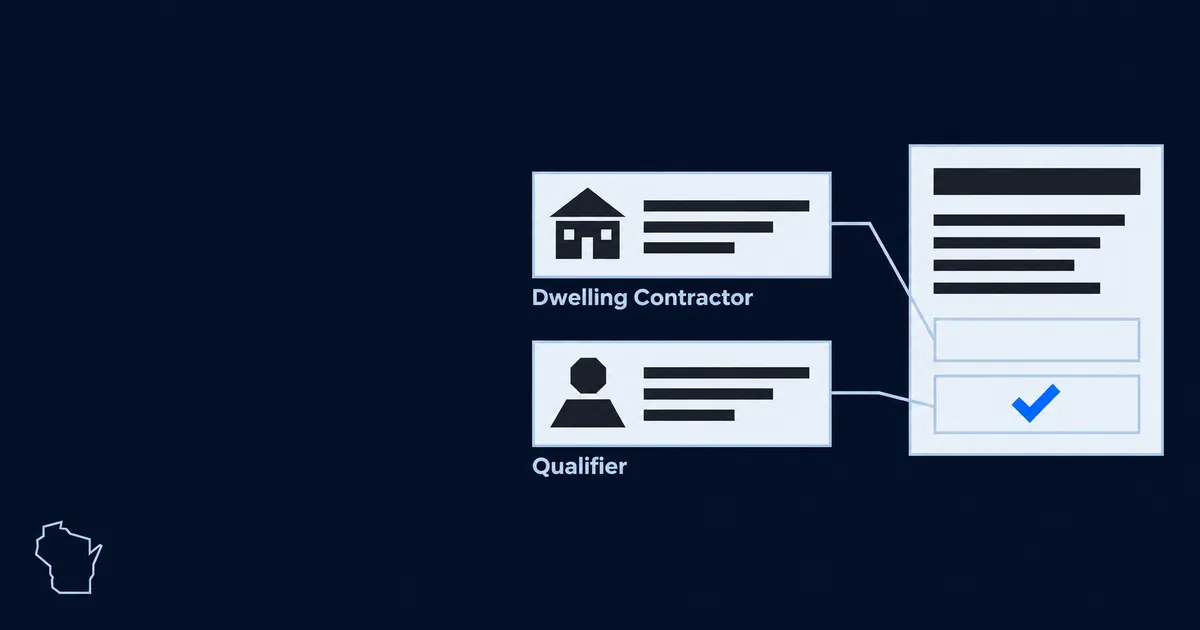
You are completing a permit application or setting up a contract. One field asks for a Dwelling Contractor number. The next asks for a Dwelling Contractor Qualifier number.
You have a card. You have taken a course. You run the company.
Why are there two boxes?
Because Wisconsin is asking about two different things: the contracting business and the individual who meets the qualifier requirements. A solo operator may be involved in both, but the credentials are not interchangeable.
The distinction in plain language
| Credential | Think of it as | What to match in your records |
|---|---|---|
| Dwelling Contractor, or the applicable Restricted certification | The contracting-business credential, including financial-responsibility requirements | The correct business or sole proprietor, credential type, number, status, and any restriction |
| Dwelling Contractor Qualifier | The individual's qualifier credential, associated with training and continuing education | The person's name, credential number, status, and relationship to the contractor |
The DSPS Dwelling Contractor application information addresses business responsibility, applicable workers' compensation and unemployment obligations, and proof of financial responsibility through insurance or a bond. The Qualifier application information addresses the individual's approved initial qualifier education.
Neither number is a general promise that every job, contract, or trade is compliant. Each answers a particular credentialing question.
When the two-credential rule matters
The key starting point is obtaining a building permit for a one- or two-family dwelling.
DSPS explains that, subject to statutory exceptions, the person obtaining that permit must hold a Dwelling Contractor or Dwelling Contractor Restricted certification and must hold a Dwelling Contractor Qualifier certification or employ someone who does.
That is more precise than saying every Wisconsin contractor needs both credentials for every task. Ask what work is being performed, which permit is involved, who is obtaining it, and whether an exception applies.
Do not reverse the logic, either. A task that does not trigger this particular two-credential requirement may still involve other licenses, permits, inspections, or legal obligations.
One person can fill both roles, but one credential cannot
Imagine a small remodeling company where the owner also serves as its qualifier.
The company's permit paperwork still needs the applicable contractor credential. The owner's qualifier number belongs in the qualifier field. Copying the owner's qualifier number into both boxes does not create the missing contractor certification.
Now imagine the qualifier is an employee. The person has the individual credential; the business has the contracting credential. If that employee leaves, an old number in the company template is not evidence that the business still meets the applicable requirement.
The rule refers to holding the qualifier credential or engaging a qualifier as an employee. Do not assume a friend, a subcontractor, or someone willing to lend you a number meets that condition. Confirm the arrangement with DSPS before relying on it. DSPS Qualifier guidance
The exceptions deserve their own check
Wis. Stat. § 101.654 includes an exception for an owner who resides or will reside in the dwelling and applies for a permit to work on that dwelling. It also contains a narrower education exception for a person holding a current DSPS occupational license who performs work covered by that license under the permit.
Those are not blanket exemptions for anything called "residential work." In particular, an education exception should not be casually rewritten as an exemption from every business, financial-responsibility, or permit requirement.
For electrical, plumbing, and HVAC work, verify the credentials and permit requirements for that trade and role. A Dwelling Contractor Qualifier credential is not an electrician's or plumber's license. An HVAC business should likewise confirm the registrations, credentials, and local requirements applicable to its work.
The cleanest question for the permit office is: "For this work, with this person or business applying, which credentials do you need to verify?"
These are not the same rules as ATCP 110
This series often discusses Wisconsin's home-improvement contract rules. The dwelling-credential requirements have a different purpose and scope.
For example, ATCP 110 excludes new-residence construction from its definition of home improvement. That does not make new-home building permits exempt from dwelling-contractor credential requirements. Check each framework separately rather than treating "not covered by ATCP 110" as "no contractor requirements." ATCP 110.01, DSPS Dwelling Contractor guidance
The same separation matters in the other direction: having current credentials does not make an incomplete contract complete.
Keep a small credential file, not a memory
For the next permit-dependent job, make these checks a high-priority part of setup:
- Confirm the exact legal business or sole-proprietor identity used on the agreement and permit application.
- Check the contractor credential's current status, type, number, and restrictions.
- Check the qualifier's current status and the qualifying relationship.
- Confirm separate trade credentials where the work calls for them.
- Save the verification date and supporting records with the project.
Use current DSPS resources for status checks and the profession pages for current application and renewal instructions. A saved card tells you what was issued. It does not necessarily tell you what is active today.
As an ongoing business habit, assign responsibility for renewals, education, and insurance or bond updates. A deadline on someone's personal calendar is easy to lose when that person changes roles. Keep it visible to whoever is responsible for the company's permits.
Put accurate information into the contract
Credential information is useful only if it belongs to the right party and is current.
If you change the business entity, replace a qualifier, or discover that an old template has the wrong number, check the source record before updating the next draft. Do not quietly alter a previously signed contract to make its history look different.
Then return to the rest of the agreement. The scope, price, dates, and responsibilities still need to describe the actual job. Credentials and clear paperwork complement each other; neither substitutes for the other.
Where ScopeAccord fits
ScopeAccord can store contractor and qualifier information and place the supplied details on generated contracts. Entering a number is not the same as verifying it with DSPS. The contractor remains responsible for accuracy, current status, and applicability.
The workflow is conversationally AI-native where you describe the job and review wording. Its legal core is deliberately deterministic, using counsel-reviewed templates and verified math. It helps organize the record; it does not issue credentials, determine permit eligibility, or replace professional judgment.
More in this series: Contractor documentation, plain and practical